


Menopause diagnosis is usually made by evaluating the person's age, changes in the menstrual cycle, and menopause-related symptoms together. In a healthy woman over the age of 45, routine hormone tests may not always be necessary when typical changes such as irregular periods, hot flashes, night sweats, and vaginal dryness are present. Menopause is not a condition confirmed by a single blood value, ultrasound image, or examination finding. The diagnostic process is planned according to the person's age and medical history.
- What Information Is Evaluated When Diagnosing Menopause?
- What Does the Cessation of Menstruation Mean in Menopause Diagnosis?
- How Does Menopause Diagnosis Vary by Age?
- Perimenopause Diagnosis
- What Questions Are Asked During a Menopause Assessment?
- Is a Blood Test Required to Diagnose Menopause?
- Which Tests Are Used to Diagnose Menopause?
- Can the FSH Test Alone Confirm Menopause?
- Is a Gynecological Examination Required to Diagnose Menopause?
- Can Ultrasound Confirm Menopause?
- How Is Menopause Assessed in Women Using Hormonal Birth Control?
- How Is Menopause Diagnosed in Women Who Have Had a Hysterectomy?
- How Does the Diagnostic Process Proceed When Early Menopause Is Suspected?
- Summary of the Menopause Diagnosis Process
- When Should You See a Doctor for Menopause Diagnosis?
- Frequently Asked Questions About Menopause Diagnosis
What Information Is Evaluated When Diagnosing Menopause?
“How is menopause diagnosed?” cannot be answered based on blood tests alone. The evaluation is primarily based on the person's menstrual history, age, symptoms, and medications.
The following information is generally considered during the evaluation process:
- The person's age
- Date of the last menstrual period
- Menstrual pattern in previous years
- Changes in the intervals between periods
- Amount and duration of bleeding
- Hot flashes and night sweats
- Changes in sleep patterns
- Mood and concentration problems
- Vaginal dryness and urinary tract symptoms
- Possibility of pregnancy
- Medications being used
- Birth control method being used
- Previous uterine or ovarian surgery
- Family history of early menopause
- History of chemotherapy or radiotherapy
Menopause assessment is not based on a single symptom. For example, a delayed period alone may not indicate menopause. Pregnancy, thyroid disorders, severe stress, and certain medications can also affect the menstrual cycle.

What Does the Cessation of Menstruation Mean in Menopause Diagnosis?
Menopause cannot be determined with certainty on the day of the last menstrual period. A woman is considered to have entered menopause retrospectively after her periods have stopped completely and no further menstrual bleeding has occurred for one year.
This definition applies to people who are not using hormonal birth control and who do not have another health condition that could cause periods to stop. Birth control pills, hormonal intrauterine devices, injections, and certain medications can alter bleeding patterns.
Vaginal bleeding that occurs again after periods have completely stopped should not be considered a normal menstrual period. In such a case, the cause of the bleeding should be investigated by an obstetrician and gynecologist.
How Does Menopause Diagnosis Vary by Age?
Menopause assessment varies according to the person's age. In particular, typical symptoms in those over the age of 45 and menstrual irregularities that begin before the age of 40 are not evaluated in the same way.
This distinction between age groups is important. The same symptom may be consistent with the natural menopausal transition in a 48-year-old woman, while it may require detailed investigation in a 35-year-old woman.
Perimenopause Diagnosis
Perimenopause diagnosis is made by evaluating changes during the transition period before menstruation has completely ended. During this period, periods may become irregular, bleeding may not occur in some months, and menopausal symptoms may increase or decrease from time to time.
Hormone levels are not stable during perimenopause. A hormone level measured as high on one day may be lower on another measurement. Therefore, a single blood test may not definitively confirm or rule out perimenopause.
The assessment considers age, changes in the intervals between periods, hot flashes, night sweats, sleep problems, and vaginal symptoms together. The person's medications and birth control methods are also included in the evaluation.
What Questions Are Asked During a Menopause Assessment?
Menopause assessment does not mean that only a gynecological examination is performed. A detailed medical history is one of the most important parts of the diagnostic process.
The following questions may be asked during the consultation:
- When was the last menstrual period?
- How have the intervals between periods changed over the past 6–12 months?
- Has the amount of bleeding increased or decreased?
- Are there hot flashes or night sweats?
- Have there been changes in sleep patterns?
- Are there vaginal dryness or urinary tract symptoms?
- To what extent do the symptoms affect daily life?
- Which medications are being used?
- Is a hormone-containing birth control method being used?
- Is there a possibility of pregnancy?
- Has there been previous uterine or ovarian surgery?
- Is there a family history of early menopause?
This information helps determine whether the symptoms may be related to the natural menopausal transition or another health condition.
Is a Blood Test Required to Diagnose Menopause?
Blood testing for menopause may not be routinely necessary for every woman. In particular, when a healthy woman over the age of 45 has typical menopausal symptoms and menstrual irregularity, the assessment can generally be based on age, symptoms, and menstrual history.
Blood tests may be considered in the following situations:
- Symptoms begin before the age of 45
- The person is under the age of 40
- The cause of menstrual irregularity is unclear
- There is a possibility of pregnancy
- Thyroid disease or anemia is suspected
- Medications being used may affect the menstrual cycle
- Periods cannot be monitored because the uterus has been removed
- The symptoms are not typical of menopause
Not requesting a blood test does not mean that the person's symptoms are being disregarded. The need for testing is determined according to the person's age and health status.
Which Tests Are Used to Diagnose Menopause?
There is no standard test panel applied to everyone when diagnosing menopause. Especially in healthy women over the age of 45, when typical symptoms and changes in the menstrual cycle are present, the diagnosis is generally assessed based on age, symptoms, and menstrual history. Because hormone levels can fluctuate during perimenopause, a single blood result may not definitively confirm or rule out menopause.
The following tests may be used when considered necessary:
-
FSH test: This is the most commonly used hormone test for assessing changes in ovarian hormone production. FSH levels may rise during the menopausal transition; however, because the values can fluctuate, the result is interpreted together with the person's age, menstrual pattern, and symptoms. It becomes particularly important in people whose symptoms begin before the age of 45 and when loss of ovarian function is suspected before the age of 40.
-
Estradiol test: This shows the level of one of the main estrogen hormones produced by the ovaries. It may decrease during menopause, but it does not establish the diagnosis on its own because of fluctuations during perimenopause.
-
LH test: This is one of the hormones that regulates ovarian function. Although its level may change during the menopausal transition, it is not routinely used on its own to diagnose menopause.
-
Pregnancy test: In people with delayed or absent periods who may still be pregnant, it may first be requested to rule out pregnancy.
-
Thyroid function tests: Thyroid disorders can cause symptoms that may be confused with menopause, including menstrual irregularity, palpitations, sweating, sleep disturbance, and weight changes. Therefore, TSH and other thyroid tests may be evaluated when necessary.
-
Prolactin test: This may be requested when other hormonal causes that could lead to absent periods are suspected.
-
Complete blood count: If bleeding is heavy or prolonged, it may be used to assess whether anemia has developed.
-
AMH test: It can provide information about ovarian reserve, but it is not routinely used to diagnose natural menopause or to determine precisely the age at which menopause will begin.
Which tests are required is determined according to the person's age, symptoms, menstrual pattern, medications, and medical history. Results should not be interpreted individually; they should be assessed by an obstetrician and gynecologist together with the examination findings and medical history.
Can the FSH Test Alone Confirm Menopause?
FSH measurement is one of the tests that helps assess changes in ovarian hormone production. FSH is secreted by the pituitary gland in the brain and stimulates the ovaries to produce hormones.
When ovarian hormone production decreases, the FSH level may rise. However, FSH levels during menopause may fluctuate throughout perimenopause. Therefore, a single high or normal result does not confirm a diagnosis of menopause.
The FSH result should be evaluated together with the following information:
- The person's age
- Menstrual pattern
- Menopausal symptoms
- The conditions under which the test was performed
- Hormone-containing medications being used
- Birth control method
Measurement methods and reference ranges may vary between laboratories. Therefore, menopause should not be self-diagnosed based on a single FSH threshold found online.
Is a Gynecological Examination Required to Diagnose Menopause?
A gynecological examination is not mandatory for every woman solely to confirm menopause. However, the examination may become important when there are changes in bleeding, pelvic pain, vaginal discharge, bleeding after sexual intercourse, or other gynecological symptoms.
The examination may be performed to assess the following conditions:
- Vaginal dryness and tissue changes
- Problems related to the uterus or ovaries
- Signs of infection
- Uterine or bladder prolapse
- Unexplained vaginal bleeding
- The source of pelvic pain
Rather than diagnosing menopause itself, a gynecological examination may help investigate other conditions that can cause similar symptoms.
Can Ultrasound Confirm Menopause?
Ultrasound during menopause is not a standard diagnostic method that can confirm natural menopause on its own. The appearance of the ovaries or uterus on an ultrasound image does not definitively show whether a person is in menopause.
Ultrasound may be requested in the following situations:
- Very heavy or irregular bleeding
- Bleeding again after periods have stopped
- Pelvic pain
- Suspected ovarian cyst
- Assessment of fibroids
- Examination of the uterine lining
- A different finding detected during a gynecological examination
Ovarian volume, follicles seen in the ovaries, or the thickness of the uterine lining are not sufficient on their own to diagnose menopause. The need for ultrasound is determined according to the person's symptoms.
How Is Menopause Assessed in Women Using Hormonal Birth Control?
Birth control pills, hormonal intrauterine devices, hormone injections, and certain implants can reduce menstrual bleeding, make it irregular, or stop it completely. Therefore, the absence of periods in a woman using hormonal birth control does not indicate menopause on its own.
Hormone-containing methods may also affect the results of certain hormone tests. The following information is considered during the assessment:
- Type of method being used
- Duration of use
- The person's age
- Menopausal symptoms experienced
- Bleeding pattern
- Other health conditions
Stopping or changing a birth control method should not be planned without an individual assessment.
How Is Menopause Diagnosed in Women Who Have Had a Hysterectomy?
In a woman who has had her uterus removed, the onset of menopause cannot be monitored through the menstrual cycle because there is no menstrual bleeding. If the ovaries were preserved, hormone production may continue after surgery.
Removal of the uterus does not always mean immediate menopause. The following information is important in the assessment:
- Whether the ovaries were preserved during surgery
- The person's age
- Hot flashes and symptoms such as night sweats
- Vaginal and urinary tract changes
- Hormone tests considered necessary
- Medications being used
If both ovaries are removed together with the uterus, hormone production may decrease suddenly. This situation is evaluated differently from the natural menopausal transition.
How Does the Diagnostic Process Proceed When Early Menopause Is Suspected?
Early menopause diagnosis may require a more detailed evaluation because of the age at which symptoms begin. Menopause-like symptoms that begin before the age of 45 are assessed in relation to early menopause. If periods become infrequent or stop completely before the age of 40, ovarian function is examined in greater detail.
The following may be considered during the assessment:
- Changes in the menstrual cycle
- Hot flashes and night sweats
- Family history of early menopause
- Previous ovarian surgery
- History of chemotherapy or radiotherapy
- Hormone tests
- Thyroid-related and other possible causes
A single hormone result may not be sufficient to diagnose early menopause. Tests are evaluated together with age, symptoms, and menstrual history.
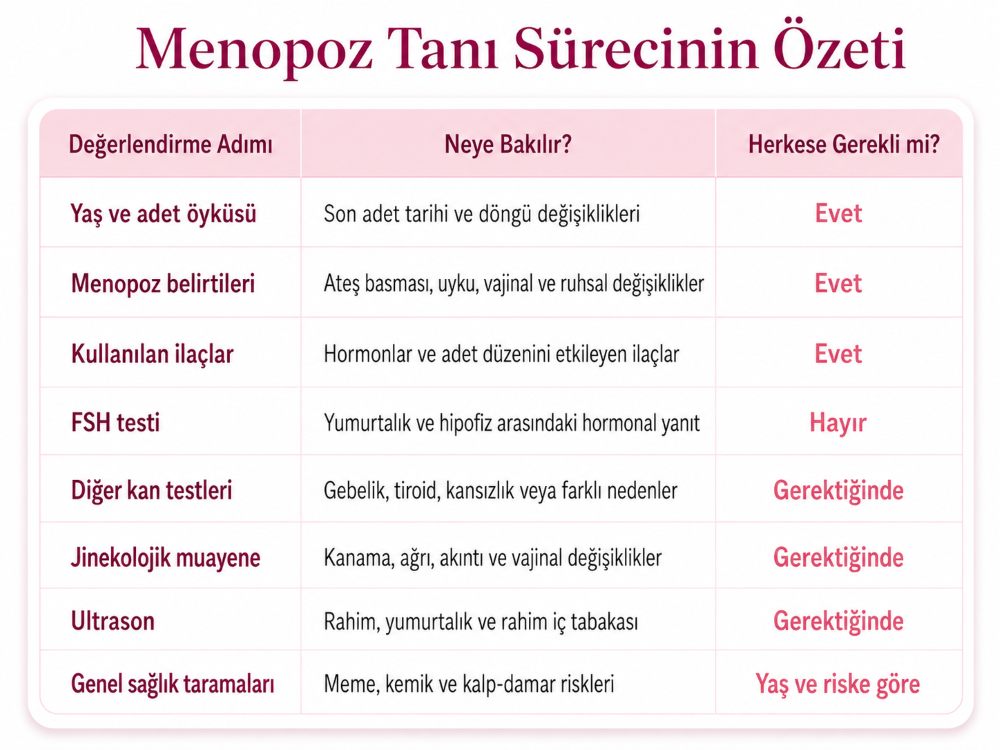
Summary of the Menopause Diagnosis Process
When Should You See a Doctor for Menopause Diagnosis?
“Which doctor should I see for menopause?” The answer is an obstetrician and gynecologist. An assessment may be sought if menopausal symptoms affect daily life or if there is uncertainty about the cause of menstrual changes.
Specialist assessment is important in the following situations:
- Symptoms begin before the age of 45
- Periods become infrequent or stop before the age of 40
- Very heavy or prolonged bleeding
- Frequent bleeding between periods
- Bleeding after sexual intercourse
- Bleeding again after periods have completely stopped
- Severe or persistent pelvic pain
- Unexplained weight loss
- New-onset noticeable palpitations
- Symptoms significantly affect daily life
Before the appointment, the date of the last menstrual period, menstrual pattern over recent months, medications being used, and symptoms experienced can be noted. This information helps the assessment process proceed more systematically.
Frequently Asked Questions About Menopause Diagnosis
Is Fasting Required for a Menopause Test?
Fasting is generally not required for hormone measurements such as FSH, LH, and estradiol. However, fasting may be requested if other blood tests are performed at the same time.
On Which Day of the Menstrual Cycle Is a Menopause Test Performed?
The timing of the test may vary depending on the hormone being measured and the person’s menstrual cycle. The evaluation may be planned differently for individuals whose periods are irregular or have completely stopped.
Are At-Home Menopause Tests Reliable?
At-home tests may detect increased FSH levels in urine, but they cannot diagnose menopause on their own. The results should be evaluated together with the person’s age, menstrual pattern, and symptoms.
Can Menstruation Continue Despite High FSH Levels?
Yes. During perimenopause, FSH levels may fluctuate, and menstrual bleeding may continue.
How Long Does It Take to Receive Menopause Blood Test Results?
The turnaround time varies depending on the laboratory where the test is performed. Most basic hormone test results may be available within a short period.
Can a Menopause Test Give an Incorrect Result?
Because hormone levels naturally fluctuate, a single measurement may be misleading. Hormone-containing medications and contraceptive methods may also affect the results.
You May Also Interested In

Why do women often have to cope with menopause symptoms on their own during the years…
Read more
The answer to the question which doctor should be consulted for menopause is the Depa…
Read more

Menopause symptoms may include changes in menstrual patterns, hot flashes, night swea…
Read more