

There is no single answer that applies to everyone when it comes to the question at what age does menopause start. Natural menopause usually occurs between the ages of 45 and 55; worldwide, the average age at the final menstrual period is about 51, while in Türkiye the average age of menopause is reported to be between 47 and 49. However, menopause-related changes can begin several years before periods stop completely. Because every woman's genetics, health history and ovarian function are different, the timing of menopause also varies from person to person.
The age at which menopause symptoms start is not the same as the age of the final menstrual period. Irregular periods, hot flashes or night sweats can begin in the early 40s, yet periods may continue for some time after that. Menopause is identified retrospectively, once a full year has passed without a period after periods have stopped completely.
What Are the Stages of the Menopause Process?
Menopause is not something that begins suddenly on a single day. Changes in hormone production by the ovaries happen over time, and the menstrual cycle may gradually lose the regularity it had in previous years.
The menopause process is considered in three main stages:
-
Perimenopause: The menopausal transition, during which changes in the menstrual pattern begin; it lasts until 12 months after the final menstrual period. During this time, estrogen levels may fluctuate, and symptoms such as irregular periods, hot flashes, and changes in sleep and mood may occur.
-
Menopause: Refers to the time of the final menstrual period. It is only after one year has passed that this bleeding is recognized as the final period.
-
Postmenopause: The stage of life after the final menstrual period.
This distinction is important. The age at which hot flashes or irregular periods begin is not directly considered the age of menopause. There may be a transition period of several years or longer between the onset of symptoms and the final menstrual period.

What Is the Normal Age of Menopause?
The normal age of menopause is generally between 45 and 55. This age range reflects the period when natural menopause most commonly occurs. One woman reaching menopause at 47 and another at 53 can both be considered normal, depending on individual characteristics.
The average age of menopause is about 51. However, this average does not mean that every woman will reach menopause at 51. This number represents the overall average of different ages at menopause and does not predict an individual's menopause date.
When answering the question “At what age do women go through menopause?”, one should not look only at the age at which one's mother, sister or other women in one's circle reached menopause. Family history can give an idea about the timing of menopause, but it is not the only determining factor.
Different studies may report different findings on the age of menopause in Türkiye. Because regional characteristics, the number of participants and assessment methods vary, it is not accurate to give a single definitive age that applies to all women. However, the average age of menopause in Türkiye is between 47 and 49.
At What Age Does Perimenopause Start?
There is no exact age in answer to the question at what age does perimenopause start. Perimenopause usually begins in the 40s, but in some women it may appear earlier or later. This stage can last for several years, and various symptoms may occur before periods stop completely.
During perimenopause, hormone levels do not decline in a steady way. Because of fluctuations in hormone production, periods may remain regular for a while, and then the intervals between periods may become shorter or longer. Some months there may be no period, while bleeding may return in the following months.
The first signs of menopause that may be noticed during this time include:
-
Longer or shorter intervals between periods
-
Changes in the amount of bleeding
-
Skipped periods in some months
-
Night sweats
-
Disrupted sleep
-
Mood changes
-
Vaginal dryness
-
Difficulty concentrating
Not all of these symptoms have to occur at the same time. In some women, irregular periods are the first change, while in others hot flashes or sleep problems may begin even though periods are continuing.
At What Age Is Menopause Considered Late?
Although different definitions may be used for late menopause age, periods continuing after age 55 may be considered later-than-usual menopause timing. However, having periods at 55 does not by itself indicate a disease.
It should be evaluated whether ongoing bleeding is a regular menstrual period and whether there is another cause of bleeding. If the amount, duration or frequency of bleeding differs from before, it should not be interpreted simply as late menopause.
Vaginal bleeding that returns after periods have stopped completely is a different matter. Even if the bleeding is light or only spotting, it should be evaluated by an obstetrician-gynecologist.
How Are Menopause Age Ranges Evaluated?
The age of entering menopause is evaluated differently depending on when it occurs. Distinguishing by age is important, especially so that irregular periods that begin early and changes in ovarian function are not overlooked.
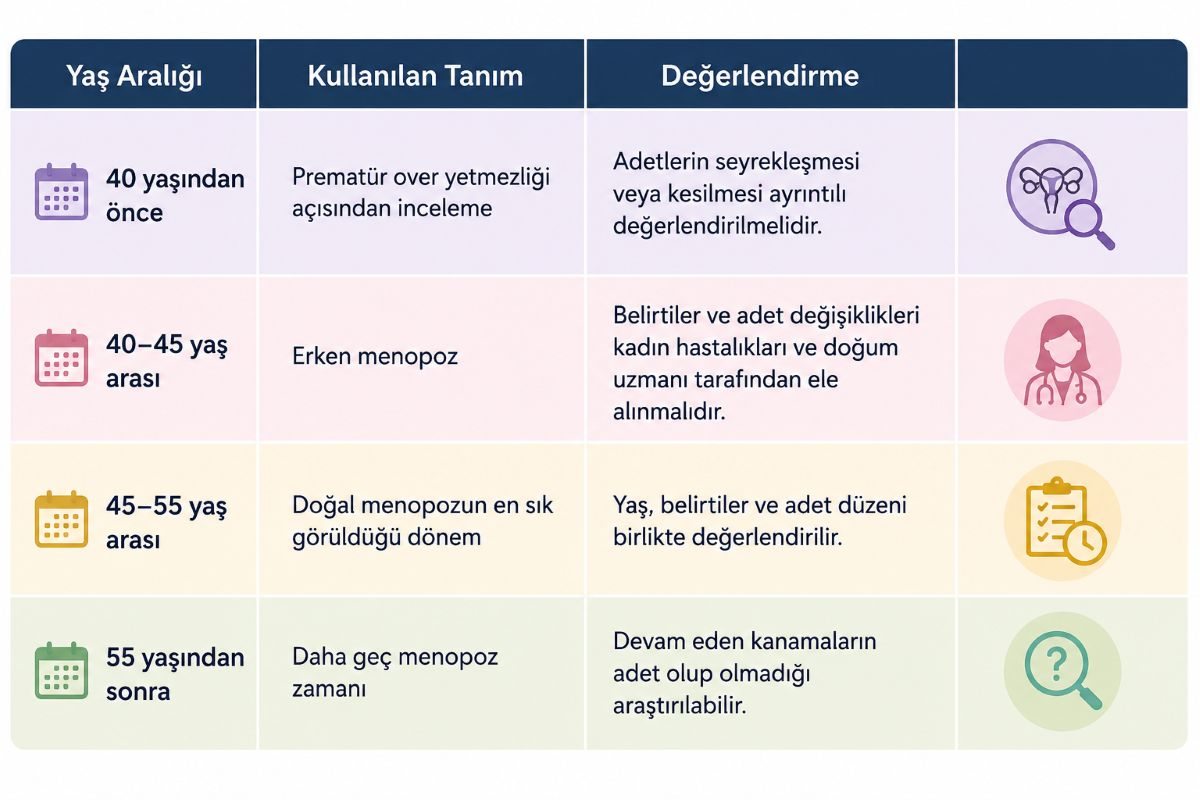
The age at which menopause starts is not determined by chronological age alone. Menstrual pattern, menopause symptoms, medications, birth control methods and personal health history are all evaluated together.
What Factors Can Affect the Age of Menopause?
The timing of menopause does not depend on a single factor. Genetics, the condition of the ovaries and certain past medical procedures can play a role in menopause occurring earlier or later.
The main factors that may be associated with the timing of menopause include:
-
The age at which women in your family reached menopause
-
Smoking
-
Surgery on the ovaries
-
A history of chemotherapy or radiation therapy
-
Certain diseases that affect the ovaries
-
Certain genetic conditions
-
Immune system–related diseases
-
Surgical removal of both ovaries
A mother having gone through early menopause does not mean her daughter will definitely reach menopause at the same age. However, family history can be taken into account, especially when evaluating menstrual changes that begin before age 45.
High stress can cause periods to be delayed or to stop temporarily. Even so, stress alone cannot be said to cause permanent menopause. Rapid weight loss, very intense exercise, thyroid disease and certain medications can also affect the menstrual pattern and lead to changes that may be confused with menopause.
Surgical removal of the uterus does not always mean immediate menopause. If the ovaries are preserved, hormone production may continue. However, because there are no periods, the onset of menopause cannot be determined by looking at the bleeding pattern. Removal of both ovaries, on the other hand, causes a sudden drop in hormone production.
Can the Age of Menopause Be Predicted in Advance?
There is no single test that shows exactly at what age a woman will reach menopause. Family history, menstrual pattern and information about ovarian reserve can help with prediction, but they do not give an exact date.
FSH levels can vary during perimenopause. Because the result may be high in one measurement and lower in another, a single FSH result does not definitively determine the timing of menopause.
An AMH test can provide information about ovarian reserve, but it does not show exactly in which year the final menstrual period will occur. Examining the ovaries with ultrasound also does not directly calculate the age at which natural menopause will begin.
Therefore, the question how can you tell your menopause age cannot be answered by laboratory values alone. Age, menstrual pattern, symptoms, medications and personal health history should all be taken into account together.
