

Menopause diagnosis is usually made by evaluating a person's age, changes in her menstrual pattern and menopause-related symptoms together. In a healthy woman over 45 who has typical changes such as irregular periods, hot flashes, night sweats and vaginal dryness, routine hormone testing may not always be necessary. Menopause is not a condition confirmed by a single blood value, ultrasound image or exam finding. The diagnostic process is planned according to the person's age and health history.
What Information Is Evaluated in Diagnosing Menopause?
The answer to “How is menopause diagnosed?” does not rely on blood tests alone. The evaluation is based mainly on a person's menstrual history, age, symptoms and the medications she takes.
The following information is usually taken into account during the evaluation:
- Age
- Date of the last menstrual period
- Menstrual pattern in previous years
- Changes in the intervals between periods
- Amount and duration of bleeding
- Hot flashes and night sweats
- Changes in sleep patterns
- Mood and concentration problems
- Vaginal dryness and urinary complaints
- Possibility of pregnancy
- Medications being taken
- Birth control method used
- Previous uterine or ovarian surgery
- Family history of early menopause
- History of chemotherapy or radiation therapy
A menopause evaluation does not focus on a single symptom. For example, a late period alone may not mean menopause. Pregnancy, thyroid disease, severe stress and certain medications can also affect the menstrual cycle.

What Does the End of Periods Mean for a Menopause Diagnosis?
Menopause cannot be confirmed on the day of the last menstrual period. A woman is determined to have reached menopause retrospectively, after her periods have stopped completely and she has gone a full year without any menstrual bleeding.
This definition applies to people who are not using hormonal birth control and who have no other health problem that could cause periods to stop. Birth control pills, hormonal IUDs, injections and certain medications can change bleeding patterns.
Vaginal bleeding that occurs after periods have stopped completely should not be regarded as a normal period. In such cases, the cause of the bleeding should be investigated by an obstetrician-gynecologist (OB-GYN).
How Does Menopause Diagnosis Differ by Age?
The menopause evaluation differs depending on a person's age. Typical symptoms after age 45 and menstrual irregularities that begin before age 40 are not approached in the same way.
| Age Group | Key Information for Diagnosis | Need for Testing |
|---|---|---|
| 45 and older | Menstrual pattern, symptoms and health history | If typical symptoms are present, routine hormone testing is often not necessary. |
| Ages 40–45 | Menstrual changes, symptoms and the possibility of early menopause | In some people, hormone tests may be ordered to support the diagnosis. |
| Under 40 | Infrequent or absent periods, ovarian function and other causes | More detailed hormone testing and investigation of the cause may be needed. |
This distinction between age groups is important. The same symptom may be consistent with the natural menopausal transition in a 48-year-old woman but may require detailed evaluation in a 35-year-old woman.
Diagnosing Perimenopause
Perimenopause diagnosis is made by evaluating the changes that occur during the transition period before periods have stopped completely. During this time, periods may become irregular, some months may pass without bleeding, and menopause symptoms may come and go.
Hormone levels are not stable during perimenopause. A hormone level that is high one day may be lower on another measurement. For this reason, a single blood test may not definitively confirm or rule out perimenopause.
The evaluation considers age, how the intervals between periods have changed, hot flashes, night sweats, sleep problems and vaginal symptoms together. The medications a person takes and her birth control method are also included in the evaluation.
What Will You Be Asked During a Menopause Exam?
A menopause exam does not mean only a gynecological exam. A detailed health history is one of the most important parts of the diagnostic process.
You may be asked the following questions during the visit:
- When was your last menstrual period?
- How have the intervals between your periods changed over the past 6–12 months?
- Has the amount of bleeding increased or decreased?
- Do you have hot flashes or night sweats?
- Have you noticed changes in your sleep patterns?
- Do you have vaginal dryness or urinary complaints?
- How much do the symptoms affect your daily life?
- What medications are you taking?
- Are you using a hormonal birth control method?
- Is there a chance you could be pregnant?
- Have you had uterine or ovarian surgery before?
- Is there a family history of early menopause?
This information helps determine whether the symptoms may be related to the natural menopausal transition or to another health condition.
Is a Blood Test Needed to Diagnose Menopause?
A blood test for menopause may not be routinely necessary for every woman. Especially in a healthy woman over 45 with typical menopause symptoms and irregular periods, the evaluation can often be based on age, symptoms and menstrual history.
Blood tests may be considered in the following situations:
- Symptoms starting before age 45
- Being under 40
- No clear cause for irregular periods
- A possibility of pregnancy
- Suspected thyroid disease or anemia
- Medications that affect the menstrual cycle
- Periods that cannot be tracked because of a prior hysterectomy
- Symptoms that are not typical of menopause
Not being asked to have a blood test does not mean your symptoms are being dismissed. The need for testing is determined by your age and health status.
Which Tests Are Used to Diagnose Menopause?
There is no standard test panel used for everyone to diagnose menopause. Especially in healthy women over 45 with typical symptoms and changes in their menstrual pattern, the diagnosis is usually based on age, symptoms and menstrual history. Because hormone levels can fluctuate during perimenopause, a single blood result may not definitively confirm or rule out menopause.
When considered necessary, the following tests may be used:
-
FSH test: This is the most commonly used hormone test for evaluating changes in the ovaries' hormone production. FSH levels may rise during the menopausal transition, but because values can fluctuate, the result is interpreted together with age, menstrual pattern and symptoms. It becomes more important especially in people whose symptoms began before age 45 and when loss of ovarian function before age 40 is suspected.
-
Estradiol test: This shows the level of one of the main estrogen hormones produced by the ovaries. It may decrease during menopause, but because of fluctuations during perimenopause, it cannot establish the diagnosis on its own.
-
LH test: LH is one of the hormones that regulate ovarian function. Although its level may change during the menopausal transition, it is not routinely used on its own to diagnose menopause.
-
Pregnancy test: In people with a late or absent period who could still become pregnant, this may be ordered first to rule out pregnancy.
-
Thyroid function tests: Thyroid disease can cause symptoms that may be confused with menopause, such as irregular periods, palpitations, sweating, sleep problems and weight changes. For this reason, TSH and other thyroid tests may be evaluated when considered necessary.
-
Prolactin test: This may be ordered when other hormonal causes that can stop periods are suspected.
-
Complete blood count: If there is heavy or prolonged bleeding, this may be used to check whether anemia has developed.
-
AMH test: This can provide information about ovarian reserve, but it is not routinely used to diagnose natural menopause or to predict precisely the age at which menopause will begin.
Which tests are needed is determined by a person's age, symptoms, menstrual pattern, medications and health history. Results should not be interpreted one by one, but evaluated by an obstetrician-gynecologist together with the exam and health history.
Can an FSH Test Alone Diagnose Menopause?
Measuring FSH is one of the tests that help evaluate changes in the ovaries' hormone production. FSH is secreted by the pituitary gland in the brain and stimulates the ovaries to produce hormones.
When the ovaries' hormone production declines, FSH levels may rise. However, FSH levels in menopause can fluctuate throughout perimenopause. For this reason, a single high or normal result does not confirm a menopause diagnosis.
The FSH result should be evaluated together with the following information:
- Age
- Menstrual pattern
- Menopause symptoms
- The conditions under which the test was done
- Hormone-containing medications being taken
- Birth control method
Measurement methods and reference ranges may vary between laboratories. Therefore, you should not diagnose yourself with menopause based on a single FSH cutoff found online.
Is a Gynecological Exam Necessary to Diagnose Menopause?
A gynecological exam is not required for every woman solely to confirm menopause. However, it may become important if there are changes in bleeding, pelvic pain, vaginal discharge, bleeding after intercourse or other gynecological complaints.
The purpose of the exam may be to evaluate the following:
- Vaginal dryness and tissue changes
- Problems involving the uterus or ovaries
- Signs of infection
- Uterine or bladder prolapse
- Unexplained vaginal bleeding
- The source of pelvic pain
Rather than diagnosing menopause, a gynecological exam can help investigate other conditions that may cause similar symptoms.
Can Ultrasound Diagnose Menopause?
Ultrasound in menopause is not a standard diagnostic method that confirms natural menopause on its own. The appearance of the ovaries or uterus on ultrasound does not definitively show whether a person is in menopause.
An ultrasound may be ordered in the following situations:
- Very heavy or irregular bleeding
- Bleeding again after periods have stopped
- Pelvic pain
- Suspected ovarian cyst
- Evaluation of fibroids
- Examination of the uterine lining
- An unusual finding on the gynecological exam
Ovarian volume, follicles seen in the ovaries or the thickness of the uterine lining are not sufficient on their own to diagnose menopause. The need for an ultrasound is determined by a person's complaints.
How Is Menopause Evaluated in Women Using Hormonal Birth Control?
Birth control pills, hormonal IUDs, hormone injections and some implants can reduce menstrual bleeding, make it irregular or stop it completely. For this reason, the absence of periods in a woman using hormonal birth control does not by itself mean menopause.
Hormone-containing methods can also affect the results of some hormone tests. The following information is taken into account during the evaluation:
- Type of method used
- Duration of use
- Age
- Menopause symptoms experienced
- Bleeding pattern
- Other health problems
Stopping or changing a birth control method should not be planned without an individual evaluation.
How Is Menopause Diagnosed in Women Who Have Had a Hysterectomy?
In a woman who has had her uterus removed, there is no menstrual bleeding, so the onset of menopause cannot be tracked through the menstrual pattern. If the ovaries were preserved, hormone production may continue after surgery.
Removal of the uterus does not always mean immediate menopause. The following information is important in the evaluation:
- Whether the ovaries were preserved during surgery
- Age
- Symptoms such as hot flashes and night sweats
- Vaginal and urinary changes
- Hormone tests considered necessary
- Medications being taken
Removal of both ovaries along with the uterus, on the other hand, can cause a sudden drop in hormone production. This situation is evaluated differently from the natural menopausal transition.
How Does the Diagnostic Process Work When Early Menopause Is Suspected?
Diagnosing early menopause may require a more detailed evaluation because of the age at which symptoms begin. Menopause-like symptoms starting before age 45 are evaluated for early menopause. If periods become infrequent or stop completely before age 40, ovarian function is examined in more detail.
The evaluation may include:
- Changes in the menstrual pattern
- Hot flashes and night sweats
- Family history of early menopause
- Previous ovarian surgery
- History of chemotherapy or radiation therapy
- Hormone tests
- Thyroid and other possible causes
A single hormone result may not be enough to diagnose early menopause. Tests are evaluated together with age, symptoms and menstrual history.
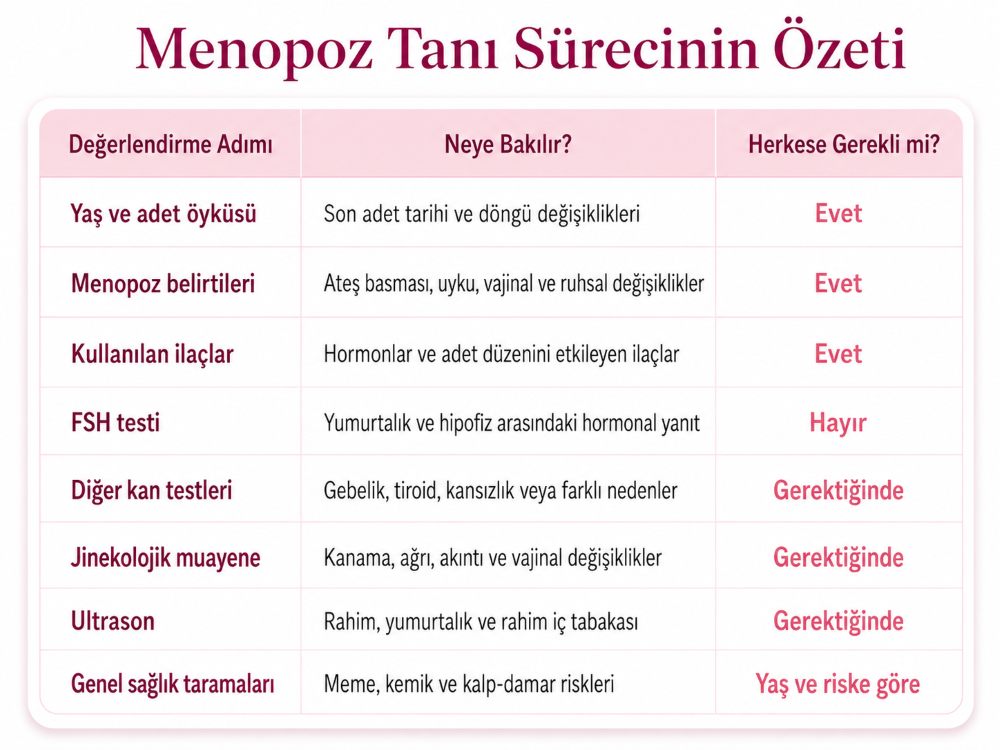
Summary of the Menopause Diagnostic Process
When Should You See a Doctor About Menopause Diagnosis?
The answer to “Which doctor should you see for menopause?” is an obstetrician-gynecologist (OB-GYN). You can seek an evaluation if menopause symptoms affect your daily life or if the cause of menstrual changes is unclear.
A specialist evaluation is important in the following situations:
- Symptoms starting before age 45
- Periods becoming infrequent or stopping before age 40
- Very heavy or prolonged bleeding
- Frequent bleeding between periods
- Bleeding after intercourse
- Bleeding again after periods have stopped completely
- Severe or persistent pelvic pain
- Unexplained weight loss
- New, noticeable palpitations
- Symptoms significantly affecting daily life
Before your appointment, you can note the date of your last period, your menstrual pattern in recent months, the medications you take and the symptoms you are experiencing. This information helps the evaluation go more smoothly.